



Stargazing in Australia's Golden Outback
- See & do
- Attractions
- Stargazing in Australia's Golden Outback
Australia’s Golden Outback is sparse; there are sprawling stations and vast, open fields as far as the eye can see. Townships - when you come across them - are quaint, sometimes barely even more than a general store and the local watering hole. This thinly spread population and lack of big-city infrastructure make the region one of the best in the world for stargazing.
Travel just a few minutes from one of the Golden Outback’s regional centres, and light pollution is little to none, creating optimal conditions for spotting constellations and galaxies. In fact, the dark night skies are so perfect that several towns in the region are now considered dedicated Astrotourism Towns.
ASTROTOURISM ACROSS THE GOLDEN OUTBACK
Pack your telescope and head towards the Wheatbelt, where you can set up at Narembeen’s Apex Park. Regular astronomers can go right ahead and align their telescopes, but beginners could benefit from using the giant planisphere in the park to pinpoint constellations. Got a camera? A short drive away is Avoca Farm, a historic homestead and known astrophotography hotspot.
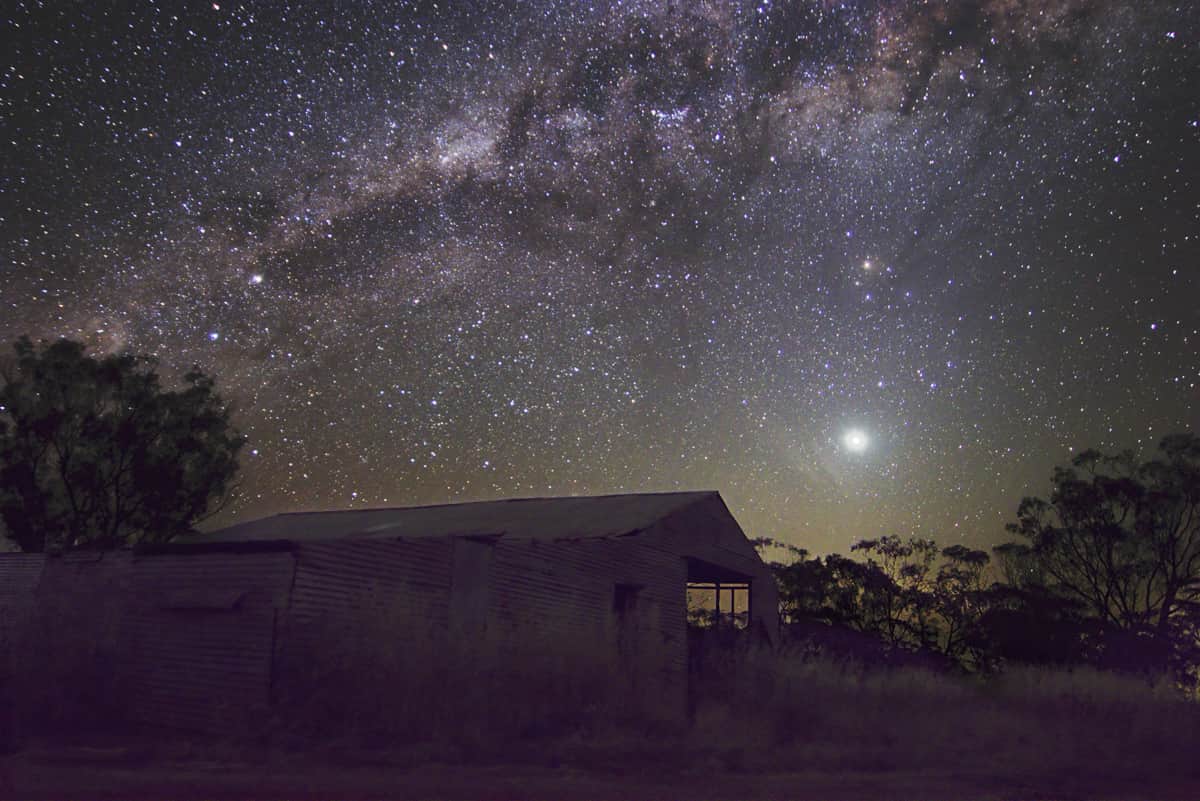
Why stop at just one Astrotourism Town? Create your own astro-trail and hop your way through the Wheatbelt from Narembeem to Hyden, Kondinin, Narrogin, Wongan Hills, Lake Grace and Darkan on a star-fuelled adventure.
Alternatively, head north to the Astrotourism Towns of Perenjori and Morawa in Mid West Wildflower Country. The entire region is yet another known favourite amongst stargazers and astronomers. The Murchison is home to the world’s largest radio telescope, the Square Kilometer Array. When complete, the telescope is set to transform our understanding of the universe.
Schedule the yearly Mt Magnet Astro Rocks Festival into your calendar. It’s a celebration of the ancient land beneath our feet and associated biodiversity, awesome night sky above and cultural connections, particularly with local Badimia people.
Travel further north and you’ll bump into the Gascoyne’s glittering night skies. There are some great reasons to take your camera and try your hand at nightscape astrophotography. Little Lagoon near Denham is a place where you’ll capture reflections of the stars in the water on a still evening. Inland from Shark Bay you’ll discover outback stars. Spend an evening at The Waterhole near Gascoyne Junction gazing at the endless night sky.
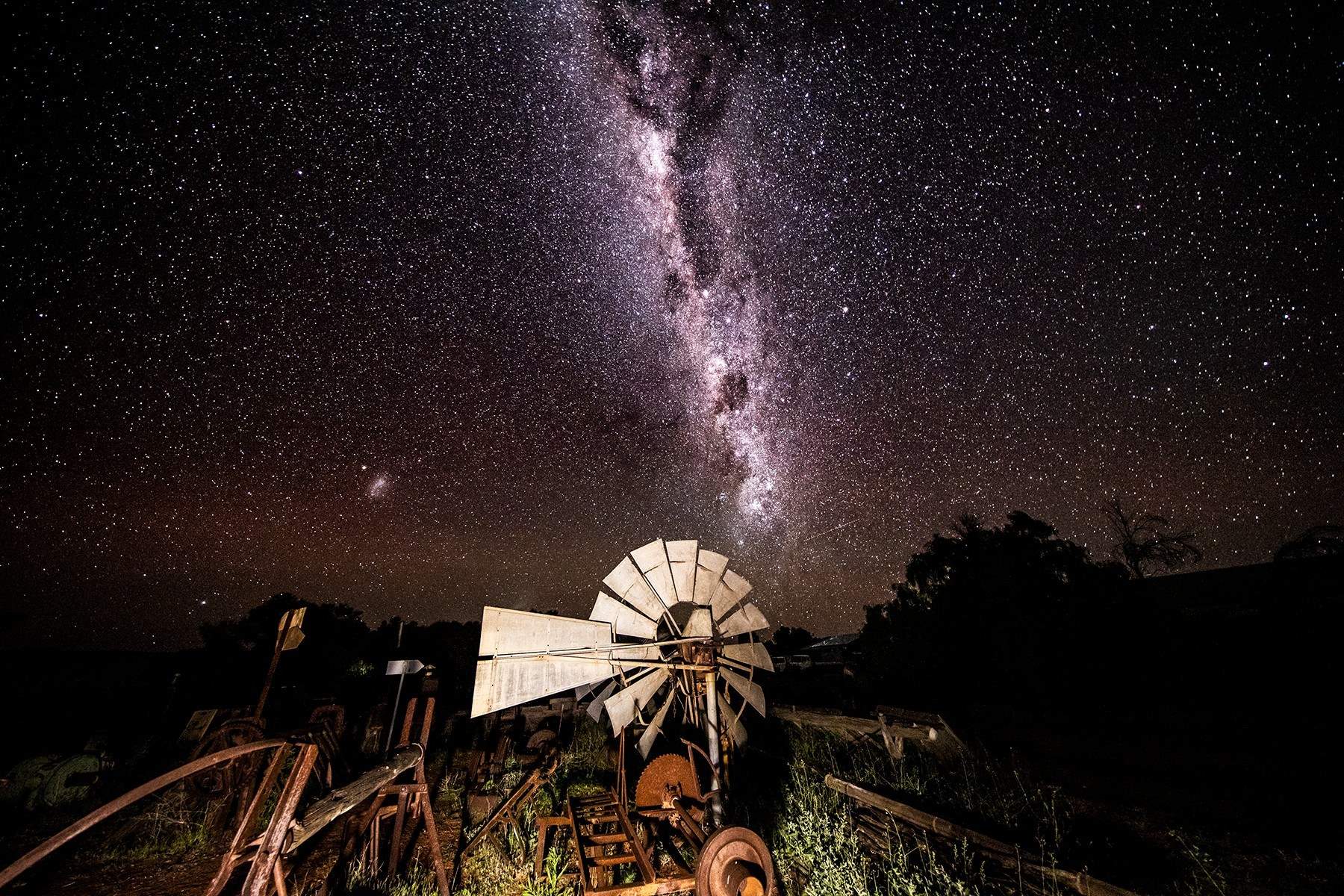
Keen photographers will have a field day in the Goldfields, with the famed Lake Ballard salt flats an otherworldly location to set up for Milky Way photos. Line up the galaxy with one of Sir Antony Gormley’s stainless steel figures for an impressive shot or set up your telescope at the new Menzies Mount Owen Observing Site. Lie back on the stargazers lounge and gaze up. Fledgling photographers and astronomy enthusiasts can build on their knowledge bank with the help of the Museum of the Goldfields, which co-hosts regular workshops and stargazing experiences with the local astro-enthusiasts.
One of the rarest night sky sights occurs in the very south of the Golden Outback. On an exceptional night, look out to the horizon at Esperance’s Lucky Bay, and you might just catch sight of the Aurora Australis — AKA the Southern Lights. Visible only in the strongest of electromagnetic storms, the phenomenon looks its best through a camera lens — shutter speed down low and aperture up high.
WHAT'S UP IN THE NIGHT SKY?
There’s a great list of what to see in the night sky from month to month on the Astrotourism WA website. Here are some of our top picks over coming months.
September: See the Total Lunar Eclipse
This impressive sight will have you up late on September 7th/8th. Watch as the Earth’s shadow crosses the surface of the Moon and turns it a stunning coppery/red colour. In WA, the Total Lunar Eclipse starts in the late evening on 7th September and the best time to start watching is from 1am on the morning of 8th September when the partial eclipse has commenced. The total eclipse begins at 1.30am (AWST) and ends at 2.52am (AWST)
October: Meteor Shower Watching
This year’s Orionids Meteor Shower is sure to put a spark in your life. It coincides with a new moon and that means the night sky will be dark to produce excellent meteor shower viewing conditions. It’s best seen from 1am on 21st October.
November to December: Go Galaxy Hunting
Did you know we have about 50 galaxies in our local Milky Way galactic neighbourhood? Two of these, the Magellanic Clouds, are close neighbouring galaxies that can be seen with the naked eye without a telescope or binoculars. All you need is a location with a very dark night sky with no moonlight. We’ve checked the lunar calendar for the best times to see the Magellanic Clouds.
January to March: Hunting with Orion
Orion the Hunter is a well-known summer constellation, and it is up in the early evening for you to see. Head outside and look directly to the east. The brightest star you’ll see is Sirius. Directly to the left of Sirius is what is often referred to as ‘the Saucepan’, which is part of the Orion constellation. Three bright stars in a reasonably straight line make up the base of the saucepan – this is Orion’s belt. Three more stars that angle out to the top right form the handle, Orion’s sword.
April: The Famous Southern Cross
The Southern Cross is Australia’s most iconic constellation. It’s on the flag and in our hearts! Did you know it can only be seen from the Southern Hemisphere? In Autumn, you can track it over time as it graces the southern skies. It’s also the best time to see one of the best-known Aboriginal constellations, the Emu in the Sky.
May to August: Milky Way Galaxy
Milky Way Season is in full swing! If you’ve never seen the Milky Way on a moonless night in Australia’s Golden Outback, June and the months either side are the perfect time to experience it. Sometimes this thick band of stars look so close, you could almost reach out and touch them. The Milky Way is simply stunning and is sought after by astrophotographers near and far. When are the right dark nights to see the Milky Way at its best?
There you have it! Australia’s Golden Outback’s top tips to our world-class dark night sky. Now all you need to do is plan your space getaway and put yourself amongst the stars!
For more to see in the night sky, check out What’s up in the Night Sky and the Astrotourism Towns map.
Travel Inspiration

Astrotourism Towns
Australia’s Golden Outback is sparse; there are sprawling stations and vast, open fields as far as the eye can see. This thinly spread population and…
 2-3 nights Southern Wheatbelt towns
Astrophotographers’ Paradise
Take a road trip to the stars and skies of Western Australia's southern Wheatbelt. During daylight hours you'll explore quaint Wheatbelt towns just…
 3-5 nights Southern Wheatbelt towns
Wheatbelt Wonders Under the Stars
Grab your camera for a mini breakaway to the Milky Way that blankets the south eastern Wheatbelt. The horizons stretch into the distance and with it,…
 3 nights Perth to Morawa return
Golden Country Stars
Escape the ordinary with this fabulous 4-day road trip. Immerse yourself in wonderful wildflowers, friendly country towns, picturesque farming…

Astrotourism WA
Astrotourism Western Australia's website features an online map that lists numerous Astrotourism Towns and dark sky locations for stargazing,…